


I Guess I’ll Start Here…
My love for writing began in the fourth grade, thanks to the kind of teacher every child deserves—Mrs. Carol Kransic. She introduced our class to journaling and gave us the rare gift of creative freedom. There were no grammar checks, no red ink, no spelling corrections. It was the first time someone handed me permission to be myself—and to put it down on paper.
Each week, I filled pages of a black-and-white composition notebook with whatever was on my heart. And the most magical part? Mrs. Kransic read every single one. She left personalized handwritten notes of encouragement—thoughtful words that said, “I see you,” “I hear you,” and most importantly, “what you think and feel matter.” Her belief in me planted a seed that’s still growing today, and I will forever be thankful.

That same year, I tried to write my first “book” about my Great Aunt Rose’s life on an old-school typewriter. I never finished it, but the dream stuck. Now, decades later, I’m still chasing that dream—with a story I never imagined I’d be brave enough to write. But that’s a post for another day.
Oh what I wouldn’t give to see the pages of that first draft. And to think how much that little girl has changed over the last 20+ years. But the one thing that hasn’t changed? I still believe writing has the power to heal, connect, and ground us.
A Legacy of Words
The love of language runs deep in my family. My grandfather—Grandpa Lem—used to say he had “a love for words.” Spoken words. Written words. The way lyrics could make you cry or the way a clever line in a movie could make you laugh out loud. He believed words were a gift.
And he lived by them.
He wrote letters to prisoners and pen pals around the world—most of whom he never met. He published articles for our local newspaper. But most memorably, he kept a lifelong collection of journals, which my Aunt lovingly transcribed after his passing. There are literally thousands of pages. Decades of life recorded, handwritten on paper.
He began journaling as a young boy, and in those early years, he wrote just two sentences a day. At first glance, it might not seem like much. But as I read them now, those short entries paint a vivid picture of his life—moments of joy, struggle, humor, and deep reflection.
That simple practice taught me something powerful: you don’t need to write a novel to leave a legacy.
My father followed in his footsteps—an avid journaler himself. Watching them both model this practice reminded me: our kids are watching. They do what we do. My love for writing was nurtured by the men who came before me—and I hope it’s something my own children will carry, too.

Why Writing Still Matters (Maybe Now More Than Ever)
We live in a world that moves fast and loud.
Notifications. Pings. Dishwasher beeps. Deadlines. Car lines. Laundry piles. TV on in every room. Radio. Podcasts. Advertisements. Pop-up ads. News headlines. Notifications (again). Sales… So. Much. Noise.
But writing invites us to slow down.
It’s a quiet rebellion in a culture of constant motion. A way to pause, reflect, and just be. For me, writing is where I sort through my thoughts, process my grief, celebrate joy, and find clarity. It’s become a daily rhythm that keeps me grounded in a life that can often feel chaotic.
That’s why I started this blog.
That’s why I keep journals and notebooks tucked in drawers, and cute pens scattered across every room in my home. I don’t write because I have extra time—I write because I need to make time for what matters.
Writing as Therapy: My Lifeline Through Grief and Growth
Writing has carried me through the hardest seasons of my life—especially the loss of my son and the journey of becoming a rainbow mama. There were days when I couldn’t say the words out loud, but I could write them. And slowly, the words helped me feel like I could breath again.
There have been seasons when my journals collected dust. But when I return to the page, I always find parts of myself waiting there.

My Morning Brain Dump: A Practice That Works
One of my favorite daily rituals is a morning brain dump—a quick, unfiltered way to clear the mental clutter. I adapted this from Mel Robbins’ Weekly 7, and it has become a game-changer.
Here’s how it works:
The Daily Brain Dump (3-Column Framework)
| Column 1: ME | Column 2: HOME | Column 3: WORK |
|---|---|---|
| Thoughts about yourself: emotions, goals, mindset, self care, things you want to do. | Thoughts about home: kids, appointments, schedules, chores, errands. | Thoughts about your job: tasks, emails, deadlines, meetings, ideas. |
I ALWAYS label the columns in this order, because it reminds me that I need to work on prioritizing my needs into my day. My kids and my family responsibilities and needs are my first priority. And work will always come after that. I do this because, I believe my family deserves the best of me, not just whats leftover after I give myself to the world. After you fill in each column, go through and cross off anything that doesn’t apply to today. (Example: I kept writing “plant spring flowers” for weeks… in December. In Illinois.)
Then look at what’s left. Remember: this is not a to-do list.
Instead, highlight or circle one thing from each column you want to focus on or accomplish today. Just one item in each column.
This helps me prioritize and direct my energy where it’s needed most.
Bonus: I also try to identify one person to reach out to that day. Maybe it’s a friend I haven’t texted in a while. Maybe it’s an email I need to send. Or simply popping into a coworker’s classroom to say hi. These small connections matter. Sometimes, they’re everything.
This practice takes just 5–10 minutes, and it gives me a clear head before the day begins.
Downloadable Graphic & Printable Template- Now Available
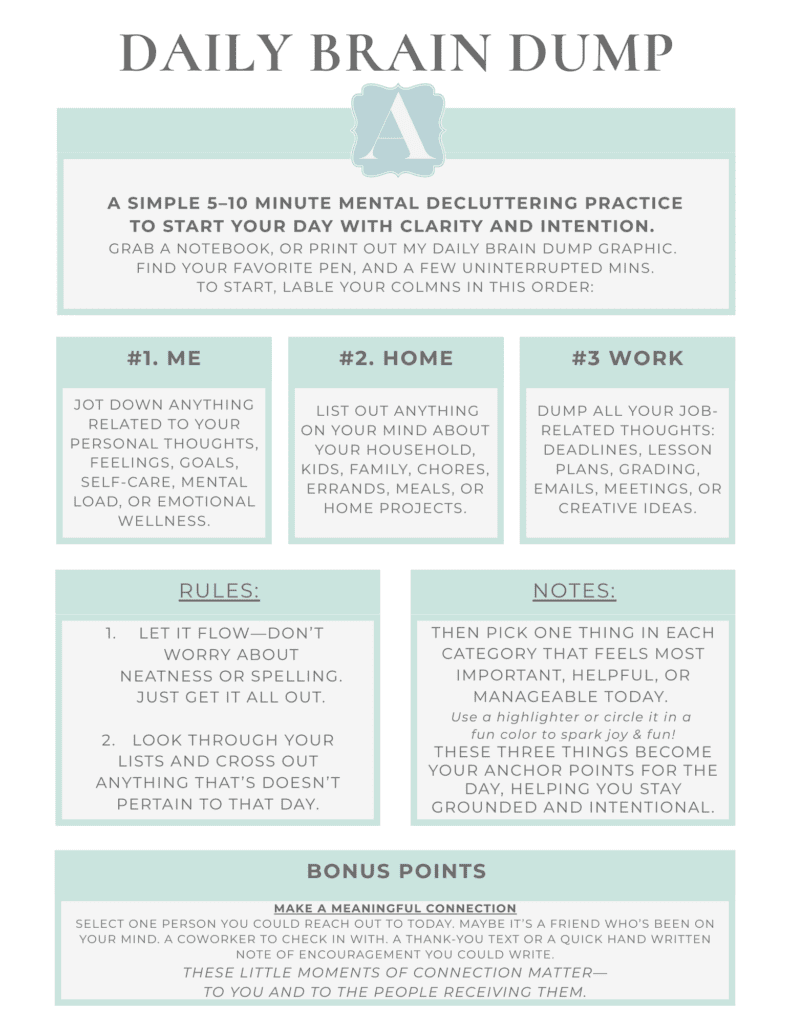
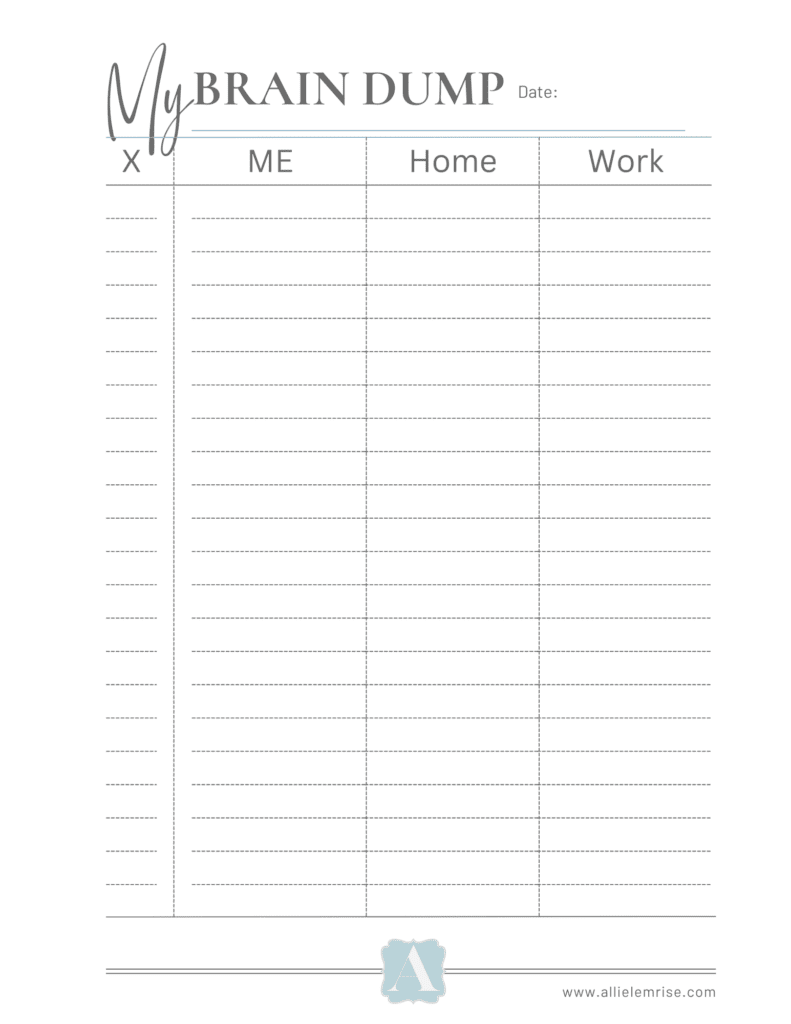
Click here to download my Morning Brain Dump template.
Ways You Can Start Writing Today
You don’t need to be a professional writer to benefit from the practice. Here are a few soulful ways to get started:
6 Soulful Ways to Begin Writing
- Journaling – Free write, sketch, or use prompts. It’s ok to be messy.
- Brain Dumps – Try my 3-column method to declutter your mind.
- Lists – Not just to-do’s—think gratitude, dreams, goals-and yes grocery lists count too!
- Paper Planners – In out digital world, actually writing it down helps calm the chaos.
- Prompt Books – Great for days when you’re stuck.
- Cute Notebooks + Fun Pens – It’s not silly. If it brings you joy, it’s important & motivating.
Your Story Matters
Friend, your story is worth writing down. Whether it’s two sentences a day or twenty pages, the act of writing has power. It helps us slow down. Reflect. Connect. Heal.
It’s not about perfection—it’s about presence.
You might not yet know who-or if anyone- will ever read your words.
But maybe that’s not the point.
Maybe the simple act of writing them is what your heart needs most.
Let’s Stay Connected
Did you have a teacher who inspired you? Do you journal? What helps you slow down and reflect?
I’d love to hear from you. Drop a comment or send me a message. Let’s make this a space where words matter, and stories bring us closer together.
Until next time—write like no one’s reading.
And maybe, one day, someone will.
And it just might change their life.
View comments
Leave comment
Did something resonate with you? Do you have a story to share? Thoughts? Feelings? I’d love to hear from you. Drop a comment or reach out directly. You never know who needs your light today.